
Museums and art galleries
Public buildings with high ADA compliance, step-free galleries, often rentable wheelchairs, and no forced separation from your date. Conversation starters built into every room.
A wheelchair dating site for manual users, power-chair users, part-time users, and ambulatory wheelchair users - plus the partners who want real connection, not a "helper" role. Free to join. Verified profiles. No devotees. No explaining your chair on every first message.
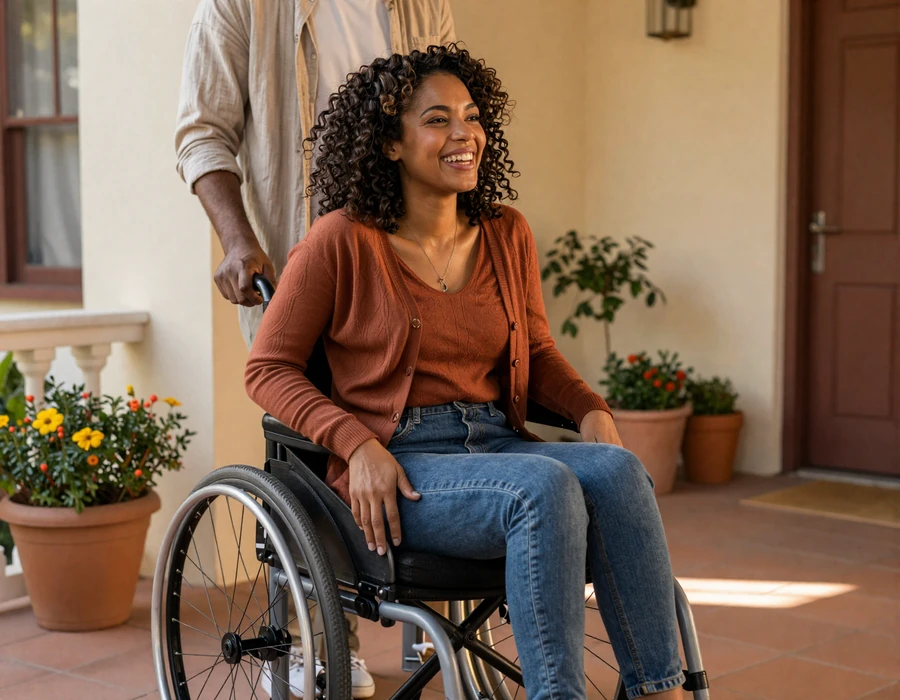
Wheelchair dating on a mainstream app is a tax. Every new profile means deciding whether to show the chair, whether to mention it in your bio, whether to brace for the same three questions about sex and mobility you have answered a hundred times. First-person accounts from long-running wheelchair dating communities report the same pattern across Tinder, Bumble, Plenty of Fish, and Hinge: profiles without a wheelchair photo get more messages, but disclosure mid-chat makes some matches feel deceived; profiles with a wheelchair photo attract comfortable contacts - plus a steady trickle of inappropriate questions no ambulatory user ever fields.
"Your mobility doesn't define you as a person. The right match already knows that before the first message." - Community principle, echoed by long-running wheelchair dating platforms since 2007
easy dating starts from a different premise. Disability is normalized from sign-up, so you never have to "come out" as a wheelchair user to each new match. Our members span the full spectrum: full-time manual and power-chair users living with SCI, spina bifida, MS, or muscular dystrophy; ambulatory wheelchair users who stand or walk short distances on good days; part-time users with EDS, POTS, or chronic pain; and the partners - interabled, ambulatory, or fellow chair users - who already understand that a chair is an extension of the person, never the whole story.
Most members arrive after the same burnout loop. Messaging someone for a week only to be ghosted once the chair comes up. Being asked "but can you…?" in the first five messages. Being called "inspirational" for using a dating app. Here, the emotional labor of disclosure shrinks to near-zero, which frees your energy for the part that actually matters: getting to know somebody. Read our broader approach on the About page, or see the platform mechanics on How It Works.
Planning an accessible date is not a limitation - it is a love language. Every venue below meets ADA standards, allows a companion seat beside the wheelchair space, and avoids the two silent killers of wheelchair dates: sand and surprise steps.
Public buildings with high ADA compliance, step-free galleries, often rentable wheelchairs, and no forced separation from your date. Conversation starters built into every room.
Every theater in the US is required to provide at least one companion seat next to the wheelchair space. Low-pressure, side-by-side, and perfect for a first meeting.
Affordable, warm, and often step-free. Call ahead to confirm the stage sight-lines from the accessible area. Shared music beats awkward small talk.
Choose parks with paved loops instead of grass. Bring a small portable table if the lawn is not level. Golden hour light does half the work for you.
Almost every lane accommodates wheelchair users with ramp bowlers. Friendly competition, built-in reason to laugh, food service right at the scoring table.
No transport stress, no accessibility gamble, no stares. Make pasta, stream a film, let the night breathe. Some of our longest-running couples met here first.
Call the venue, don't trust the website. The word "accessible" often hides a "small step at the entrance," a too-narrow restroom door, or a freight elevator that closes at 7pm. Five minutes on the phone prevents the entire night from collapsing.
Disclosure is a tool, not a confession. On a disabled dating site, the question is less whether to mention your chair and more how you want to frame the parts of your life it shapes: transportation, access needs, spontaneity, intimacy. Here is a pragmatic order of operations many of our members use.
Include one clear wheelchair photo and one face-forward photo. Add a short line in your bio - "Manual chair user, 8 years post-SCI, very independent" - so the conversation can skip the twenty questions. This filters out anyone who was never going to work, fast.
Many long-time wheelchair daters limit online chat to about a week before meeting or video-calling. You learn more about compatibility in thirty minutes of voice than thirty days of texting - and you stop investing energy in people who only seem safe on a screen.
If a direct question comes early, a steady line like "Yes, I use a wheelchair. Happy to answer respectful questions, but I'd rather focus on getting to know each other" (adapted from Special Bridge community scripts) reclaims the conversation without shutting it down.
Saying "I can't do the vineyard hike, but I'd love the winery terrace" is not disclosure - it's planning. The more your access needs land as normal preferences ("I need a paved path," "I need to eat by 7"), the less they feel like a reveal.
Curious, respectful questions about daily life are fair game early. Questions about sex, bladder care, or transfers are not - not until you have built the kind of trust where they belong. A partner worth your time already knows that order.
For a deeper walk-through, our inclusive dating advice guide and communication in relationships guide cover disclosure timing, boundary-setting, and messaging rhythms across the spectrum.
If you are new to dating a wheelchair user, you already know enough: you are dating a person, not a condition. The table below is a starter guide, not a test. The Reeve Foundation and long-running community resources agree on most of it.
| Situation | Do | Don't |
|---|---|---|
| Eye level | ✓ Sit down after a few minutes of standing so you're both at eye level. | ✕ Keep standing and talking down for the whole conversation. |
| The chair itself | ✓ Treat the chair as an extension of the body - ask before touching it. | ✕ Lean on, drape over, or push the chair without permission. |
| Offering help | ✓ Ask "Would you like a hand?" and accept the answer. | ✕ Grab, lift, or redirect without consent - even with good intentions. |
| Planning the date | ✓ Vet venues in advance for ramps, wide aisles, accessible restrooms. | ✕ Suggest a sandy beach, a cobblestone street, or an unverified "cute spot." |
| Stares from strangers | ✓ Follow your date's lead on whether to address or ignore them. | ✕ Make a show of defending them unless they ask for it. |
| Conversation | ✓ Ask the same questions you'd ask any date - work, art, family, dreams. | ✕ Open with questions about sex, bladder function, or "what happened." |
| Roles | ✓ Be a partner: flirty, curious, present. | ✕ Slide into full-time "helper" - it kills chemistry fast. |
Three members from the easy dating community. Different chairs, different lives, the same hope: a partner who sees the whole person first.
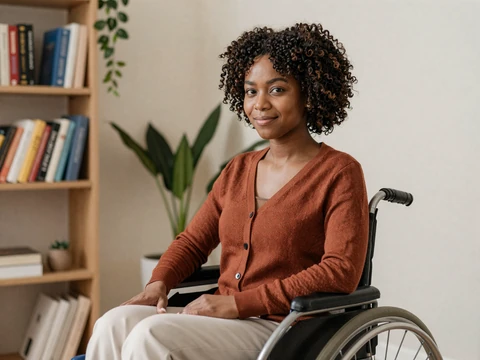
Portland, OR
Poet, plant mom, adaptive kayaker. Manual chair, 8 years post-SCI. Looking for someone who reads slowly and sends long voice notes.
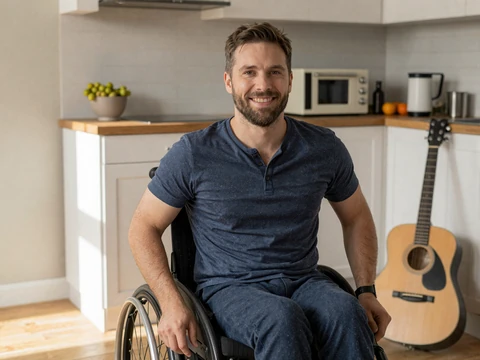
Chicago, IL
Power-chair user living with MD. Audio engineer, bad cook, good listener. Divorced, honest, done with apps that treat me like a novelty.
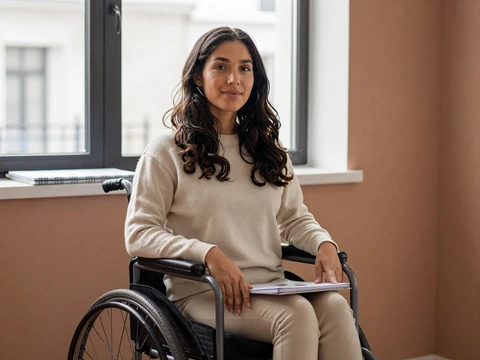
Atlanta, GA
Ambulatory wheelchair user with EDS. Illustrator, coffee enthusiast, slow dater. Chair-on-flare-days, walker-on-good-ones. All of it is me.
Read longer success stories from our wheelchair user members →
Accessibility is not a menu page here - it is how the product is built. These are the features most used by our wheelchair user members.
Every profile, message, and filter works without a mouse - helpful if you use a head switch, sip-and-puff, joystick, or adaptive keyboard. Focus states are visible at WCAG 2.1 AA contrast.
Minimum 48px on every button - designed for members with tremor, limited fine motor control, or one-handed use. No microscopic swipe gestures that hide whole features.
Written "about me" blocks and mood tags carry the same weight as photos, so chair users are not judged in half-second photo-stack decisions.
Tested with NVDA, JAWS, VoiceOver, and TalkBack. Layouts survive 200% browser zoom without horizontal scroll. Alt text on every member photo.
Every profile is verified before it goes public - which cuts the romance-scam and catfish risk that disabled women in particular face on mainstream platforms.
Accounts that fetishize wheelchairs or disability are removed on sight. Reports are reviewed within 24 hours, no back-and-forth, no "warnings."
Full details on our Safety & Privacy page, with the broader accessibility guide in our accessibility in dating article.
AKA, BKA, AE, BE - devotee-free dating across every level of limb difference.
The full CP spectrum - interabled dating without the "are you their carer?" questions.
Voice intros, audio-first messaging, and screen-reader-first profile design.
The questions we hear most often from wheelchair users joining a dating community for the first time.
Yes - several. In 2026 the most active wheelchair-friendly options are easy dating, Dateability, Special Bridge, AbiliMatch, and WheelchairDatingClub (established 2007, one of the longest-running). Unlike Tinder or Bumble, these platforms normalize wheelchair use from sign-up, meet WCAG accessibility standards, and enforce anti-devotee policies so matches arrive respectful by default.
The same way you date anyone else, with four adjustments: (1) plan step-free, pre-vetted venues - always call, never trust "accessible" on a website; (2) sit down so you share eye level; (3) ask before offering any physical help, and accept the answer; (4) treat the chair as an extension of the body - don't lean on it or push it without consent. Lead with curiosity about their art, work, and dreams, not their mobility.
Yes. All core features - creating a profile, browsing members, sending messages, video verification, and accessibility tools - are free forever with no credit card required. Optional premium verification badges are available for members who want an extra trust signal, but they are never required to meet someone.
No. It is entirely your choice. That said, community experience suggests that including at least one clear chair photo plus a face-forward photo filters conversations faster and prevents the "I felt deceived" reaction some mainstream-app matches have when disclosure happens mid-chat. Many members post both; the choice stays yours.
Every profile passes selfie-video verification before going public. Behavior suggestive of disability fetishization - asking for specific chair photos, sexualized questions about mobility, or language pulled from known devotee communities - triggers account removal. Our moderation team reviews every report within 24 hours, and blocked users cannot create new accounts on the same device.
Yes. Members with EDS, POTS, MS, chronic fatigue, chronic pain, and other conditions that mean sometimes-chair, sometimes-walker, sometimes-neither are fully welcome. You can describe your chair use however fits your life - there is no "enough disability" test to join.
That can actually go well. Partners new to dating a wheelchair user often do best when they approach with honest curiosity instead of pretending to know everything. Share the communication guide and the etiquette table above - then let them ask respectful questions as trust builds. What you are screening for is humility, not experience.