
Ask about access before guessing
Pre-researching a venue's ramps, bathrooms, and pathways is not hassle - it is one of the clearest love languages a non-disabled partner can speak. "I called ahead" lands harder than flowers.
A cerebral palsy dating site for adults who happen to have CP - and for the partners, allies, and interabled couples who want relationships built on care, not caretaking. Spastic, athetoid, ataxic, mixed. Walking, rolling, or somewhere in between. Free forever. Verified profiles. Slower pacing respected, not penalized.
Cerebral palsy is a group of disorders affecting movement, balance, and posture. It is not a single condition with a single presentation. Some adults with CP walk independently and you might never know they have it; others use walkers, canes, or power wheelchairs. Speech ranges from entirely unaffected to severely impacted, and communicates through a mix of voice, devices, or text. Many people with CP have typical intelligence; some live with co-occurring cognitive or learning differences. The one thing every adult with CP has in common is that nobody can predict their life from the diagnosis alone.
That matters for dating, because the first assumption most strangers make about a partner with CP - that the relationship must be limited, careful, or somehow incomplete - is built on a stereotype rather than any real person. Freelance journalist Sam Harris, who has CP and has written publicly about being in a long-distance relationship for seven years, puts it simply: dating with CP has enriched rather than limited his life. That is the voice this page is built around.
"Rejection related to CP reflects the other person's limited perspective, not your worth. Shared community reinforces confidence." - Adapted from AbiliMatch CP dating guidance, December 2025
On easy dating, your profile can carry as much or as little about your CP as you want to share. Some members lead with it in a short story preview; others treat it as a detail a match can learn about on date three. Both are welcome. Our inclusive dating advice guide talks through the disclosure timing question in more depth.
Adults with CP face specific, often under-discussed challenges around intimacy and body image. Many grow up experiencing their body as something to correct - stretches, braces, therapies - and describe a kind of dissociation that can make physical affection feel emotionally loaded even when it is deeply wanted. The UP (Adult Cerebral Palsy Movement) organization points out that targeted sex and relationships education for young disabled people is "almost non-existent," which leaves adults filling gaps later, often with a partner.
Good CP dating is, in large part, a communication practice. That is as true for the partner with CP as it is for anyone else they date. A few patterns our members describe working:
The communication in relationships guide goes deeper on reflective listening and flexible care plans - both of which matter more than average in CP partnerships.

An interabled couple is simply a romantic partnership between a disabled and a non-disabled person - one configuration of human love, not a charity project. These are the habits our interabled members name again and again when asked what keeps the relationship romantic instead of clinical.
Pre-researching a venue's ramps, bathrooms, and pathways is not hassle - it is one of the clearest love languages a non-disabled partner can speak. "I called ahead" lands harder than flowers.
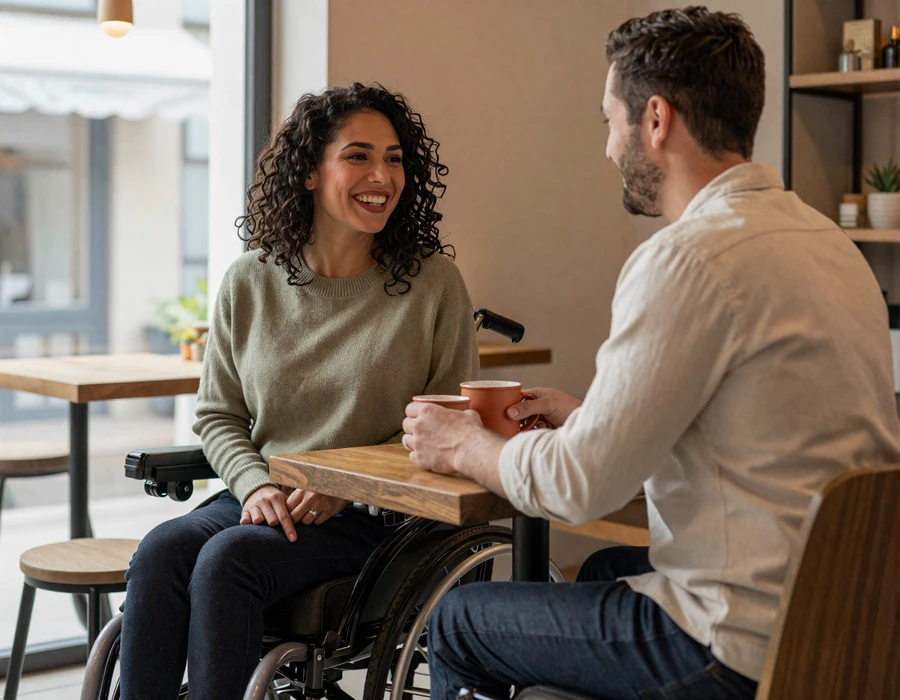
If your partner uses a wheelchair, pull up a chair. Standing over someone for the length of a conversation turns a date into a therapy session. Eye level is romance - posture is.
Mobility aids are an extension of the person, not an obstacle to the person. Don't move a wheelchair without asking any more than you would move your partner's arm.
Full-time helper mode erodes chemistry faster than any disability ever could. Split the logistics. Outsource what can be outsourced. Protect time where you are just two people on a date.
Fluctuating energy - especially with co-occurring chronic pain or fatigue - may shorten a date. It is a data point about the body that day, not the relationship.
"Would you like a hand with that?" is always welcome. Lunging in to lift, push, or carry without checking is not. Assume competence first; offer second.
Many of our CP members are in interabled relationships. Others are dating another disabled partner. Both are loved here - and neither is treated as the exceptional case. Our myths about disability and relationships guide takes the "saint / caregiver" framing apart in detail.
Accessible date planning is not a separate, sadder version of dating. It is just dating, with one extra phone call. The small checklist below covers most of what our CP members wish they could hand to a new partner on date one.
Everyone with CP has a slightly different access list - step-free entry, an accessible restroom, a quiet corner, a short walk from parking. Ask them to name three things that make a venue comfortable, then plan around those.
Restaurants, parks, and theaters often mark themselves "accessible" when only the front door is. Call ahead. Ask specifically about the path from parking to table to bathroom. Ten minutes on the phone saves a ruined evening.
Adapted sports, outdoor trails with paved surfaces, museum visits, cooking nights at home, accessible-friendly concerts, low-key coffees. Avoid anything that was designed around standing for an hour.
Fatigue, tight muscles, or a long day can cut a date short. Decide early how either of you can say "I'm done" without embarrassment. A simple "I had a great time; I'm going to head home" works in any relationship.
If the first date was a success, the instinct is to escalate. Resist it. A walk, a home-cooked meal, or a movie night often builds real intimacy faster than a fourth booked restaurant.
"I'll drive; you pick the music" is a logistics conversation, not a romance-killer. Partners who can plan comfortably together usually live well together later, too.
More ideas - and the accessibility questions worth asking any venue - live in our accessibility in dating guide.
"Are you his carer?" is the sentence most interabled CP couples hear somewhere in their first year. It is rarely malicious. It is almost always rooted in the same old assumption - that disability and romance cannot share the same room. Sam Harris, writing about his own relationship, cites it as the single comment that most consistently erases the depth of what he and his partner actually share.
How you handle it is your call. Some couples educate; some joke; some walk away. There is no right answer. What helps is to have a short, rehearsed line that lets you keep your evening intact. A few of our members shared theirs.
Follow your partner's lead on the response. Don't correct the stranger on their behalf unless you've agreed to. Your job in that moment is not to educate the room - it is to let your partner steer a social experience that is happening to them more than to you. A simple, quiet "no, I'm their partner" usually resets the tone without making a scene.
There will be weeks where the comment lands harder than others. Our confidence and self-acceptance guide covers the slow work of not letting strangers define how you see your relationship.
Two stories that keep coming back up in our community - one long-distance, one long-standing - illustrative photos, real tone.
We met in a hemiplegia Facebook group in 2010, talked online for two years before a first date at a football match that ended 3-3. We live three hours apart and typically see each other once a month. Seven years in, I still think the long-distance shape is part of why it works - we never took each other's time for granted.

I was a fan of the documentary King Gimp long before I met Dan. I wrote to him; we kept writing; eventually we were living in the same house. People ask me what it is like to be married to a man with severe CP and I never know how to answer, because mostly it is like being married.

Accessible date ideas, disclosure tips, and a community where rolling up is the first move, not the obstacle.
Disclosure frameworks, seizure plans, and calm date environments for singles with epilepsy and their partners.
The 3-3-3 and 3-6-9 pacing rules, must-haves vs deal-breakers, and how to avoid the caregiver trap.
What members with CP - and their partners - ask when they first join.
Yes. Adults with cerebral palsy date, partner, marry, and raise families at every severity level of CP. Freelance journalist Sam Harris, who has CP, has written publicly about being in a long-distance relationship for seven years and describes dating with CP as enriching rather than limiting his life. The belief that CP prevents romance is a social stereotype, not a medical reality.
Disclose when it feels like a natural part of describing your life, not as a warning label. Many members note CP in their profile story preview so matches arrive already informed; others bring it up on date two or three as part of talking about their day-to-day. Either is fine. What works less well is treating CP as a confession - it frames the condition as a negative before the match has a chance to respond.
An interabled couple is a romantic partnership between a disabled and a non-disabled person. It is one of many configurations of human love - not a charity arrangement and not a caregiving role. The healthiest interabled relationships treat disability as one feature of the partner, not the center of the dynamic, and outsource caretaking tasks to paid support or shared systems wherever possible.
Ask your date for three access needs (step-free entry, accessible bathroom, quiet corner, etc.), then call the venue to verify - websites often overstate accessibility. Pick an activity that is mutually enjoyable and doesn't require standing for long stretches. Build in a graceful exit so fatigue doesn't end the evening badly. Coffee in the late morning, a botanical garden with paved paths, or a home-cooked meal are strong first-date choices.
Have a short, rehearsed line ready so the moment doesn't derail your evening. A simple "No, we're partners" works. Some couples prefer humor; others educate briefly; others walk away. There is no correct answer. If you're the non-disabled partner, follow your partner's lead rather than correcting strangers on their behalf - the social experience belongs to them first.
Yes. We intentionally do not show read receipts or typing indicators, and there is no expectation of fast replies. Video and voice messages are supported for members who find typing tiring. Members can also note communication preferences in their profile so matches know what works best from the start.
Yes. Profile creation, browsing, messaging, verification, and all safety tools are free forever with no credit card required. Optional premium verification badges exist for members who want an extra trust signal, but they are not required to meet anyone. Full pricing transparency lives on our FAQ page.